Brussels, 28 August 2025
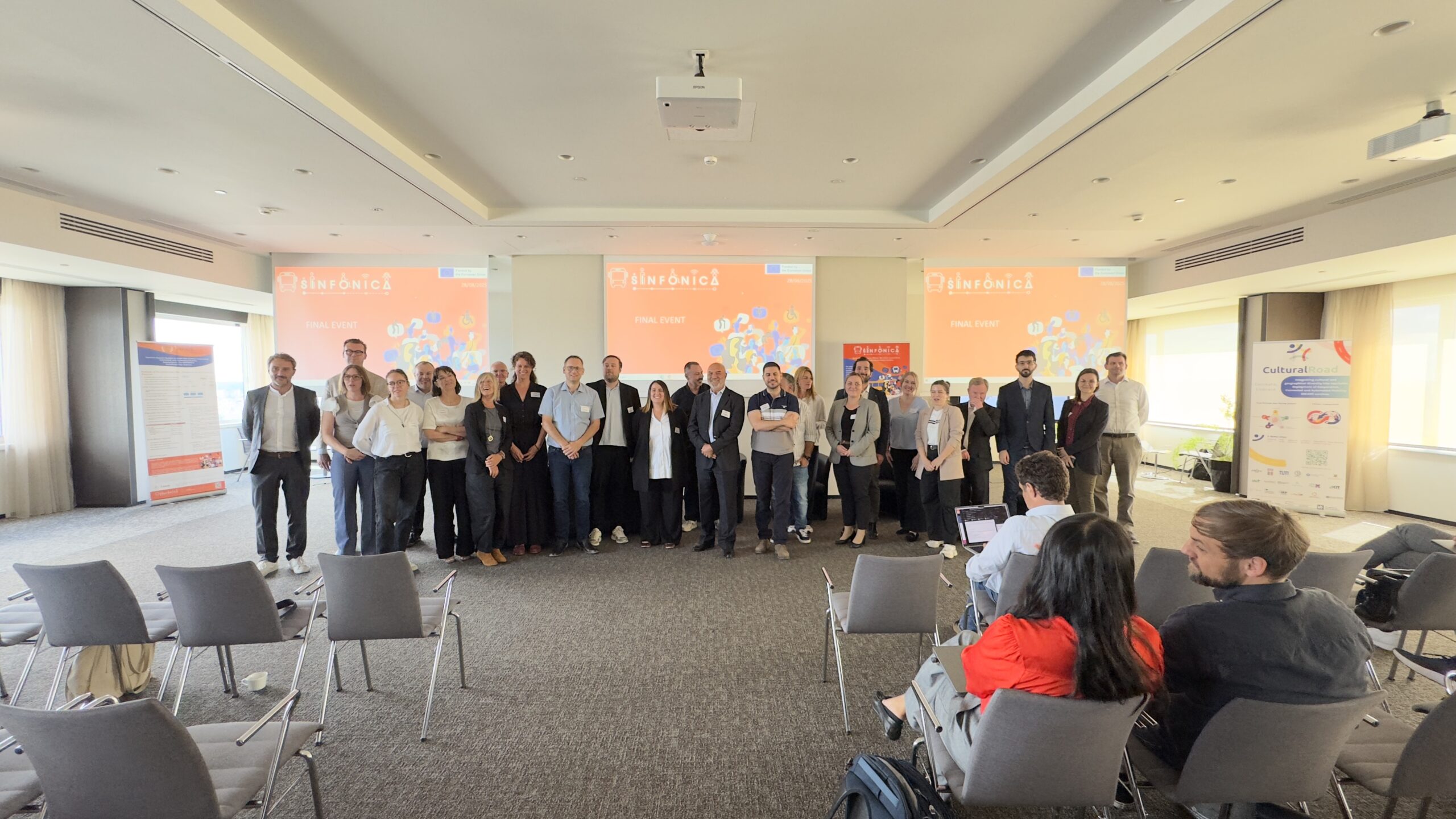
The SINFONICA project reached a remarkable milestone with its Final Event held in the prestigious “The Hotel” in Brussels, bringing together over 70 stakeholders from across Europe, to celebrate three years of innovative research in Connected, Cooperative and Automated Mobility (CCAM). This flagship event represented not just the conclusion of an ambitious research journey, but the successful culmination of a project that has fundamentally transformed how we approach inclusive, equitable, and user-centric mobility solutions across Europe.
The event, which ran from 9:30 to 15:30, showcased how SINFONICA has successfully supported the transition toward sustainable and accessible mobility, by focusing on public and shared road passenger transport – including automated shuttles and connected buses. From the moment participants gathered for registration and welcome coffee, the atmosphere was one of celebration, mixed with serious reflection on the significant achievements accomplished over the project’s duration. The diverse array of attendees, representing policymakers, CCAM developers, service operators, public authorities, researchers, and civil society organizations, demonstrated the broad impact and recognition that SINFONICA has achieved within the European mobility ecosystem.
The morning began with an impressive opening session that underscored the project’s significance within the broader European research and policy landscape. Project Coordinator Mauro Dell’Amico, from the SINFONICA Coordinator UNIMORE/ICOOR, welcomed participants and set the stage for a day of knowledge sharing and future-oriented discussions. The institutional support for SINFONICA’s outcomes was powerfully demonstrated through welcome notes from key European stakeholders: Andrea De Candido from DG RTD and Maria Cristina Galassi from DG Grow represented the European Commission’s commitment to CCAM development, while Marzena Jougounoux from CCAM Partnership highlighted the project’s alignment with European strategic objectives. The presence of industry and association leaders including Ted Zotos from IRU, Laura Babio Somoza from POLIS, Lidia Signor from UITP, and Carmen Frigerio from PAVE EU, underscored the widespread recognition of SINFONICA’s contribution to the CCAM ecosystem and the strong institutional support for translating its outcomes into real-world applications.
Following this high-level opening, the Technical Coordinator Giulia Renzi, from UNIMORE, presented the compelling vision of SINFONICA, articulating how the project has developed co-created strategies, methods, tools, and policy recommendations to effectively involve a broad spectrum of stakeholders throughout its duration. Her presentation highlighted the project’s innovative approach to stakeholder engagement, emphasizing how SINFONICA has consistently prioritized the voices of users – particularly people with mobility challenges – in shaping the future of automated mobility. The vision presentation demonstrated how the project has moved beyond traditional technology-focused approaches, to embrace a truly human-centered perspective on CCAM deployment, ensuring that future mobility solutions are not just technologically advanced but socially inclusive and culturally sensitive.
One of the event’s most engaging segments featured insights and lessons learned from SINFONICA’s four Groups of Interest, expertly moderated by Giacomo Cantini from UNIMORE. This session brought together representatives from each research site, to share their unique experiences and valuable learnings. Maren Link from the municipality of Hamburg presented Hamburg’s approach to integrating CCAM solutions into an established urban mobility framework, highlighting the challenges and opportunities of implementing automated shuttles in a complex metropolitan environment. Georgios Gorgogetas from E-Trikala shared the Greek perspective, demonstrating how smaller cities can leverage CCAM technologies to enhance public transportation accessibility and efficiency. Lars Meijer from Noord-Brabant Province provided insights from the Netherlands, showcasing how regional authorities can facilitate CCAM deployment through supportive policy frameworks and stakeholder coordination. Each presentation revealed the diverse contexts and approaches that have enriched SINFONICA’s research, demonstrating that successful CCAM implementation requires tailored strategies that respond to local needs, cultural contexts, and existing transportation infrastructures.
The innovative marketplace session represented a unique opportunity for hands-on engagement with SINFONICA’s technological and methodological innovations. Participants were divided into three groups and rotated through interactive stands every 15 minutes, ensuring everyone had direct exposure to the project’s key outputs. The EU Survey stand, led by TUD, presented comprehensive findings from SINFONICA’s extensive stakeholder consultation process, revealing critical insights about user perceptions, concerns, and expectations regarding CCAM deployment. The SINFONICA Knowledge Map Explorer (KME) stand, led by ICCS, demonstrated how the project has developed sophisticated decision support tools for capturing, organizing, and sharing knowledge about inclusive CCAM implementation. The SINFONICA CCAM Designer simulation tool stand, led by IRTSX, showcased advanced modeling capabilities that allow stakeholders to test and evaluate different CCAM scenarios before real-world deployment. This marketplace format fostered dynamic interactions between participants and project experts, creating opportunities for detailed discussions about practical applications and future development possibilities.
The afternoon panel discussion, expertly moderated by Giulia Renzi, exemplified SINFONICA’s commitment to knowledge sharing and collaboration within the broader European research ecosystem. This session brought together representatives from five related EU projects, each presenting their initiatives and exploring how SINFONICA’s outcomes could be leveraged to enhance their own work. Ignacio Magallón from Diversify-CCAM project discussed strategies for ensuring diversity and inclusion in CCAM development, finding natural synergies with SINFONICA’s focus on vulnerable user groups. John Paddington from the project CulturalRoad explored how cultural factors influence mobility choices and CCAM acceptance, aligning closely with SINFONICA’s emphasis on culturally sensitive implementation approaches. Johanna Kallio from OPTIPEX project presented optimization strategies for public transport systems, complementing SINFONICA’s work on operational practices. Guy Fournier from ULTIMO shared insights on urban logistics and last-mile delivery solutions, while Satu Innamaa from theFAME project contributed perspectives on freight and mobility integration. These presentations and subsequent discussions demonstrated how SINFONICA’s findings will continue to influence and support future CCAM research and deployment across Europe, creating a legacy of collaborative knowledge development that extends far beyond the project’s official timeline.
The presentation of SINFONICA’s recommendations for future research and policy development, delivered jointly by Andrew Winder from ERTICO and Riccardo Enei from ISINNOVA, represented the culmination of three years of intensive research and stakeholder engagement. Their comprehensive overview emphasized the project’s focus on user needs and stakeholder engagement, highlighting how successful CCAM deployment requires continuous dialogue with communities and systematic attention to diverse user requirements. They presented detailed operational practices for inclusive mobility, demonstrating how service design, infrastructure planning, and technology deployment can be optimized to serve all citizens effectively. The communication strategies outlined in their presentation showed how building trust and accessibility requires transparent, multilingual, and culturally appropriate outreach efforts. Perhaps most importantly, their policy framework recommendations provided concrete guidance for public authorities seeking to create supportive regulatory environments that promote public value while encouraging innovation.
As Mauro Dell’Amico delivered his concluding remarks, the full scope of SINFONICA’s achievements became clear. The project has successfully created a comprehensive framework for ensuring that future CCAM solutions respond to societal expectations and are designed to promote trust, accessibility, and public value for all citizens, with particular attention to vulnerable user groups. The project’s innovative approach – involving users, mobility providers, public authorities, industry, researchers, and civil society throughout the research process – has created a robust foundation for the next generation of CCAM deployment across Europe. The methodologies developed, tools created, and relationships forged during SINFONICA’s duration will continue to influence how Europe approaches automated mobility, ensuring that technological advancement serves social progress and inclusive development.
The event’s conclusion with a goodbye cocktail provided an informal setting for continued networking and collaboration planning, ensuring that SINFONICA’s impact extends well beyond the project’s official timeline. Conversations continued over refreshments as participants exchanged contact information, discussed potential future collaborations, and reflected on the insights gained throughout the day. Many attendees expressed enthusiasm for implementing SINFONICA’s recommendations in their own contexts, while others explored opportunities for joint funding applications and continued research partnerships. This networking component proved as valuable as the formal presentations, demonstrating that SINFONICA has succeeded in creating a lasting community of practice around inclusive CCAM development.
The success of the SINFONICA Final Event reflects not only the dedication of the entire consortium but also the active engagement of stakeholders throughout the project’s lifecycle. From the initial visioning workshops to the final policy recommendations, SINFONICA has demonstrated that meaningful stakeholder engagement produces better research outcomes and more implementable solutions. As the project concludes, the knowledge created, tools developed, and relationships established will continue to drive innovation in inclusive, user-centric mobility solutions across Europe and beyond.
Visit our website to access all project deliverables, publications, and tools developed during SINFONICA’s three-year journey toward more inclusive CCAM deployment.